The atrocity prevention field has been through a shock. Recent efforts to streamline U.S. foreign policy resources have significantly reduced dedicated atrocity prevention expertise and tools. Other countries, especially in Europe, are now following suit with similar...
Mass Atrocities
One Indispensable Nation? Decentering the Global Atrocity Prevention Architecture
Despite the spread and institutionalization of international atrocity prevention over the past 30 years, our field is in crisis. The continued violence in Haiti, Iran, Lebanon, Myanmar, Palestine, Sudan, and Ukraine underscores only the most recent failures of the...
Evolving Tools, Eroding Will: Challenges of Confronting Russia’s Atrocities in Ukraine
Since February 24, 2022, 185,231 criminal proceedings related to war crimes have been registered by the Office of the Prosecutor General of Ukraine, with 140 new cases filed every single day. Civilian casualties, both injuries and fatalities, have been rising since...
The Power of Local Networks in Preventing Atrocities: Lessons from Central Africa
The evolution of international efforts to stop a brutal insurgency in Central Africa could offer important lessons for preventing mass atrocities, especially at a time when international norms and systems are fraying. Between 2011 and 2017, targeted U.S. support –...
Addressing Trauma, Mitigating Atrocities: Toward More Integrated Prevention
Any effective response to mounting global violence and atrocities must address the significant associated trauma of those on the frontlines and beyond, especially children. An estimated 1.6 billion children, or roughly 65% of the global population under the age of 18,...
The Future of Atrocity Prevention: A Fight We Cannot Abandon
The atrocity prevention community faces an existential question: How do we continue our work when the fundamental norm of trying to stop mass atrocities no longer appears to be a given? The future surely looks bleak; dedicated expertise, tools, resources, and...
The International Court of Justice and Genocide in Gaza
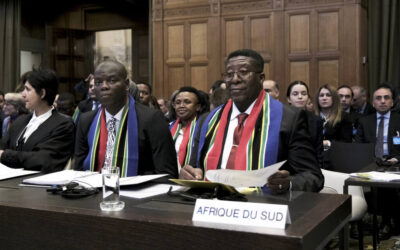
It is difficult to predict at this stage the impact of South Africa’s application to the International Court of Justice (ICJ) charging Israel with genocide over its response to Hamas’s October 7 attack and massacre.
Atrocity Crimes and the UN Prevention Agenda
Adam Lupel Mass atrocity crimes are presently occurring in seven countries, according to the Global Centre for the Responsibility to Protect, and populations are at imminent risk of falling victim in at least two other countries. We continue to develop new tools to...
Understanding Mass Atrocities
Ernesto Verdeja This year marks the seventieth anniversary of the United Nations Convention on the Prevention and Punishment of the Crime of Genocide and the Universal Declaration of Human Rights, adopted in 1948 by a world traumatized by the horrors of World War II....
UN Sanctions as a Tool for Preventing Atrocities
George A. Lopez United Nations Security Council sanctions continue to be used frequently to address a range of peace and conflict issues, from nuclear nonproliferation to the prevention and settlement of armed conflict. UN sanctions have also been utilized for...